Could Recent Discoveries Unravel the Mystery of Women in a Medieval Cemetery?
Published: 2026-01-01 01:00:24 | Category: technology
Recent discoveries at a medieval cemetery in Wales are shedding light on a unique burial site predominantly for women, potentially linked to an early female religious community. Archaeologists have unearthed significant artefacts, including exquisite glass beads and a possible small building that might serve as a chapel or shrine, raising questions about the lives and status of those buried there.
Last updated: 17 October 2023 (BST)
What’s happening now
The archaeological team led by Dr Andy Seaman from Cardiff University is currently excavating a cemetery site within the grounds of Fonmon Castle, near Cardiff Airport. Over the last four years, they have uncovered 58 skeletons, mostly of women, dating back to the 6th or 7th century. Recent digs have revealed the outline of what appears to be a small building, indicating that the site may have served as a location for early Christian worship. This significant finding has prompted further investigation into the nature of the community that existed there and the reasons behind the burial practices observed.
Key takeaways
- The cemetery predominantly contains the remains of women, suggesting a possible early female religious community.
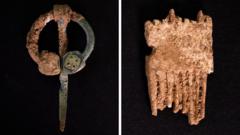
- Artefacts such as decorative brooches and glass beads indicate a level of wealth and craftsmanship.
- A potential small building uncovered could be a shrine or chapel, inviting exploration into early Christian practices.
Timeline: how we got here
The excavation has been ongoing for four years, with key milestones including:
- 2019: Initial excavations begin at the Fonmon Castle site.
- 2020: Discovery of numerous skeletons, predominantly female, begins to raise questions about the community.
- 2022: Artefacts indicating wealth and a domestic lifestyle are unearthed.
- October 2023: New findings suggest the presence of a small building, potentially a religious structure.
What’s new vs what’s known
New today/this week
The discovery of a potential small building at the cemetery site marks a significant development. This structure may be linked to early Christian practices, suggesting that the site was not merely a burial ground but also a place of communal significance. The presence of artefacts such as ornate brooches and glass beads further supports this idea.
What was already established
Previous excavations have revealed that the cemetery contains predominantly female skeletons, suggesting a possible religious community focused on women. Artefacts indicating domestic life, such as pottery and grinding stones, highlight that this was a living community and not just a burial site.
Impact for the UK
Consumers and households
While the immediate impact on consumers and households is minimal, the findings contribute to the understanding of historical communities in the UK, enriching cultural heritage and tourism potential in the region.
Businesses and jobs
The ongoing excavations may stimulate local economies through increased tourism and interest in historical education. Archaeological projects often create jobs and opportunities in related fields, such as conservation and public engagement.
Policy and regulation
As the site is of historical significance, it may attract attention from heritage preservation organisations and local councils, potentially leading to discussions on conservation policies and funding for archaeological research.
Numbers that matter
- 58: The number of skeletons uncovered, predominantly female.
- 6th-7th Century: The estimated dating of the burial site.
- 3mm: The diameter of the exquisite glass beads found, indicating fine craftsmanship.
Definitions and jargon buster
- Artefact: An object made by a human being, typically an item of cultural or historical interest.
- Quern stone: A stone used for grinding grain into flour.
- Gilded: Covered thinly with gold leaf or gold paint.
- Early Christianity: The period of Christian history from the life of Jesus Christ until the establishment of Christian doctrines and institutions.
How to think about the next steps
Near term (0–4 weeks)
The archaeological team will continue excavations and analyses of the artefacts found, which may provide further insight into the community's lifestyle and beliefs.
Medium term (1–6 months)
Further studies of the remains and artefacts are expected, potentially leading to new publications and discoveries regarding early Christian practices in Wales.
Signals to watch
- Reports on the findings from Cardiff University regarding the burial practices and artefacts.
- Potential exhibitions or publications detailing the discoveries at the Fonmon Castle site.
- Further developments in understanding the social structure of early medieval communities in Wales.
Practical guidance
Do
- Stay informed about the ongoing excavations and findings from the Fonmon Castle site.
- Visit local museums or exhibitions that may showcase artefacts from this period.
- Engage with historical societies or groups interested in medieval studies.
Don’t
- Don't overlook the importance of historical contexts in understanding archaeological findings.
- Don’t assume all burial practices were the same; cultural variations existed.
- Don’t dismiss the significance of women in early medieval history.
Checklist
- Follow updates from Cardiff University and local news regarding the excavation.
- Research the historical context of early Christian communities in Wales.
- Explore local heritage sites related to the findings.
- Engage with online resources or webinars on archaeological practices and discoveries.
- Consider volunteering with local archaeological groups to gain hands-on experience.
Risks, caveats, and uncertainties
While the discoveries at the cemetery site are significant, there remains uncertainty regarding the exact nature of the community and their practices. The presence of a few male remains and the unusual burial practices of some women necessitate further investigation. Additionally, interpretations of artefacts and their cultural significance may change as more evidence comes to light.
Bottom line
The ongoing excavations at the Fonmon Castle cemetery are unlocking fascinating aspects of early medieval life in Wales, particularly concerning women's roles in society. As archaeologists continue their work, the findings may reshape our understanding of early religious communities and their social structures.
FAQs
What is the significance of the Fonmon Castle excavation?
The Fonmon Castle excavation is significant because it uncovers a predominantly female burial site, suggesting the existence of an early female religious community in Wales during the 6th or 7th century.
What artefacts have been found at the site?
Artefacts found include ornate brooches, glass beads, pottery, and a quern stone, indicating both decorative and domestic aspects of life for the community.
What are the next steps for the archaeological team?
The archaeological team will continue excavations and analyses of the remains and artefacts, aiming to uncover more about the community's practices and structures.